Finger strength training · iOS

Your plan reads what you actually did.

Most training apps hand you a fixed programme and leave you to it. Deadpoint builds your plan from your grade, your equipment and your weak points — then works out what you should do today, based on the sessions you've actually logged.

£0.99/month or £9.99/year · cancel any time

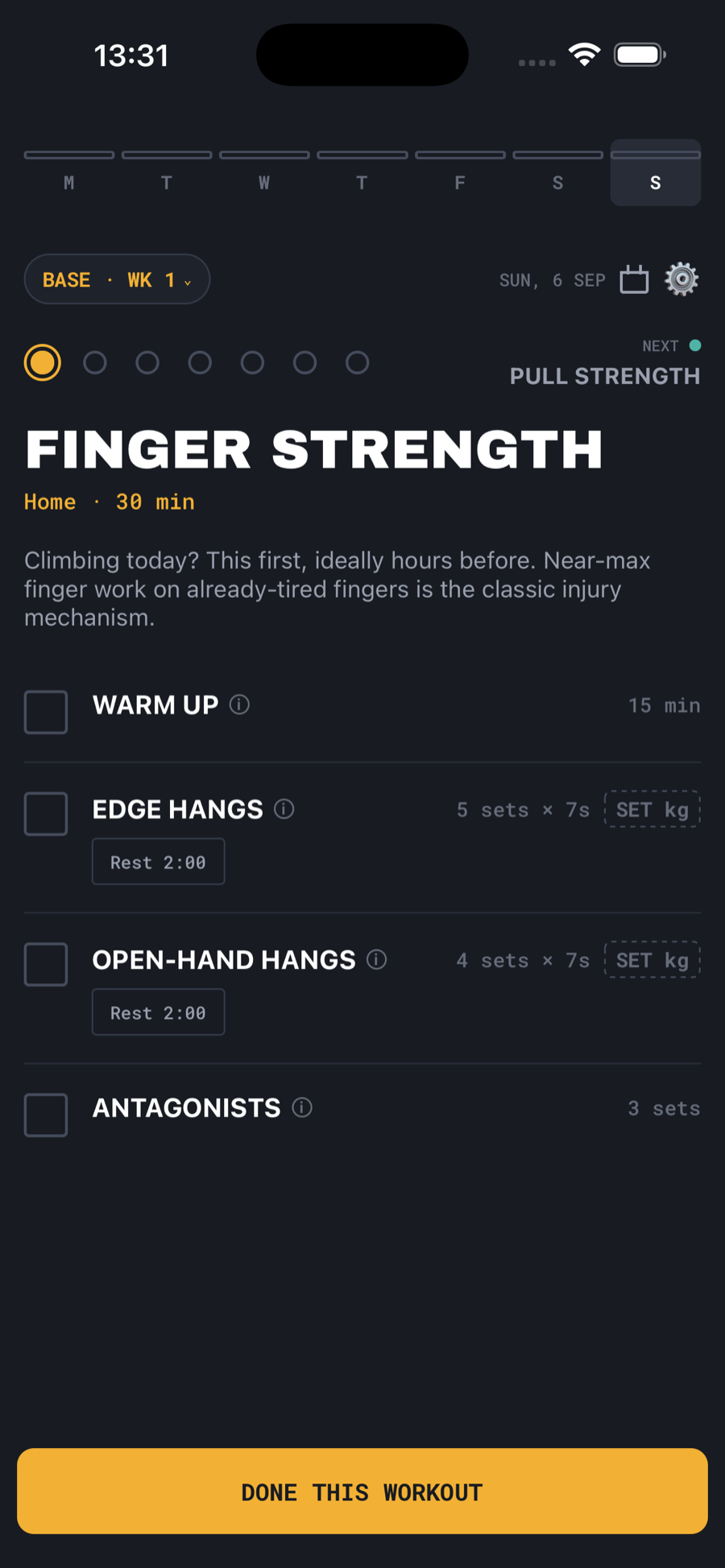
The Deadpoint daily card, showing today's session, its exercises, rest timers and a Done This Workout button.
The problem

A plan that ignores your week isn't a plan.

Hangboarding on fingers that are still cooked from Tuesday isn't training — it's how pulleys go. But a printed 12-week programme has no idea you climbed hard yesterday, that you've had three days on the trot, or that you don't own half the kit it assumes. Deadpoint does, because it reads your log before it decides anything.

4base programmes — bouldering or sport, intermediate or advanced
7things from the quiz reshape it: days, kit, weaknesses, injuries, trips
6injury and weakness modules that insert real prevention work
1decision recalculated every single day, from your actual log
The algorithm — running live on this page

Tell it your last three days. Watch it decide.

This isn't a mock-up or a marketing simulation. The panel below is running the exact rules engine that ships inside the app — same file, same logic — in your browser. The reasoning underneath each recommendation is the app's own words, not copy written for this page.

Deadpoint rules engine live · running the shipped engine
What did you do the last three days?
Your profile
Discipline
Level
Days per week
4
Equipment

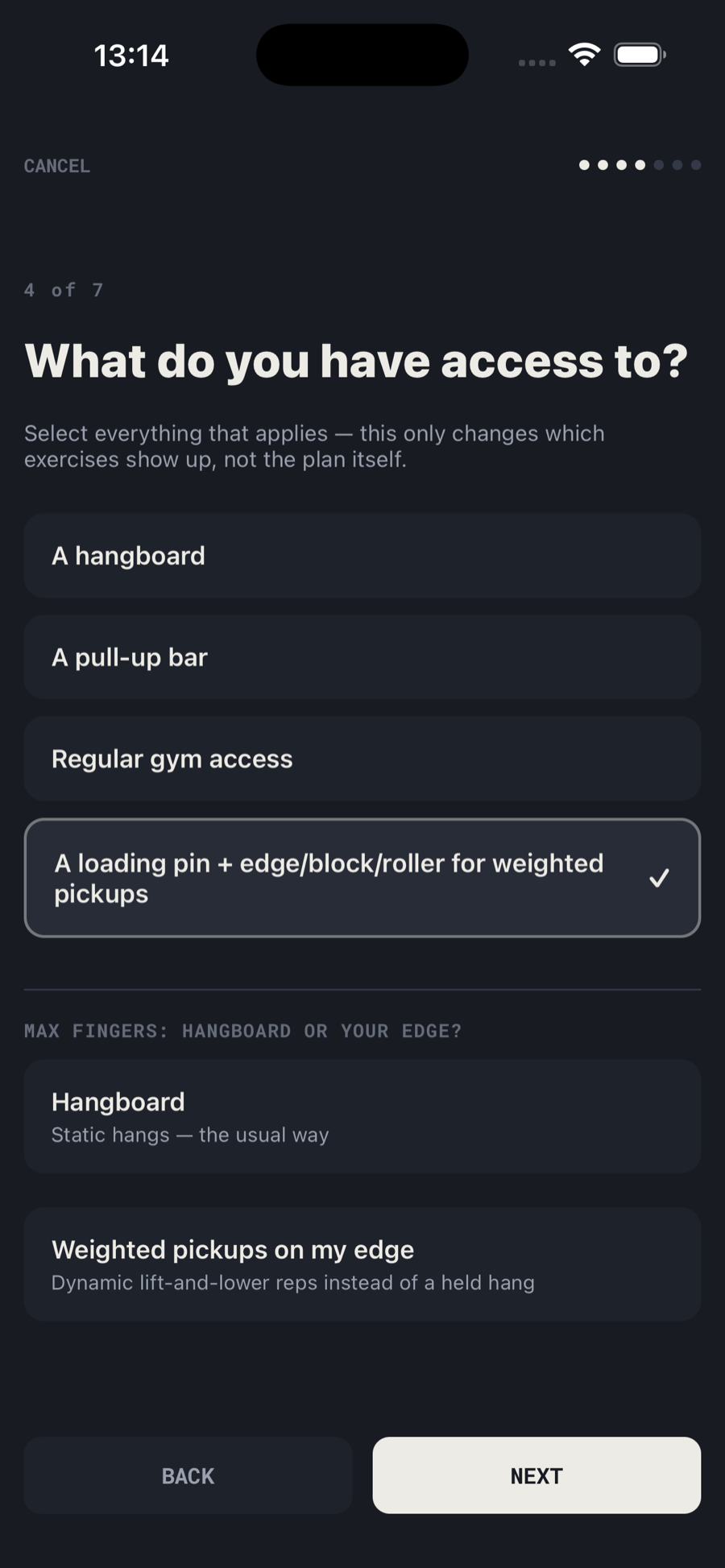
Kit changes which exercises appear — most visibly on pulling days, since finger work runs on any edge.

Today's recommendation
Then the three days after

Try three finger sessions in a row, then try three rest days — the recommendation and its reasoning both change.

Personalisation

Three climbers, three genuinely different plans.

Every example below is generated by the real resolver from the answers shown — not illustrations drawn for this page.

Climber A

Intermediate boulderer. Trains 3 days a week. Owns a hangboard, nothing else.

Their Max Fingers day Weighted or edge max hang Secondary position hang

Pull day drops the bar work they can't do — no pull-up bar, no gym.

Climber B

Same grade, same discipline. Trains 5 days. Has a pickup rig and prefers it.

Their Max Fingers day Weighted pickup — half crimp Secondary position hang

Main lift swapped entirely, and the week runs at five days instead of three.

Climber C

Advanced sport climber, 4 days. Flagged an elbow history and wants sloper work.

What changes + Open-hand sloper hangs + Elbow caution on every pulling session

Four phases including a dedicated Power Endurance block A and B never see.

Change your mind later, without starting over

Got a pull-up bar for Christmas? Gym membership lapsed? Trip booked for April, and you want to pivot from bouldering to sport for it? Change the answer in Settings and the plan updates from that day forward — your logged history, your block and your week count all carry on exactly where they were. Nothing resets.

The app

One card a day. Everything on it earns its place.

Deadpoint's daily card 1 2 3 4 5
  • 1
    Where you are in the block

    Phase and week, always visible. Tap it for the whole plan — phases, deload weeks, and what changes when.

  • 2
    The ringed dot is today's call

    One dot per session type. The ringed one is what the engine reckons you should do — and it stays put while you look around at the others.

  • 3
    Weights that tell you when to go up

    Log what you actually lifted. When the number turns gold, you've held the same weight twice running — that's your cue to add.

  • 4
    Rest timers, in the row

    Every timed exercise has its rest wired in. Tap it and put the phone down — it keeps running.

  • 5
    The bit that actually matters

    Logging the session is what the engine reads tomorrow. One button, and the next day's decision changes because of it.

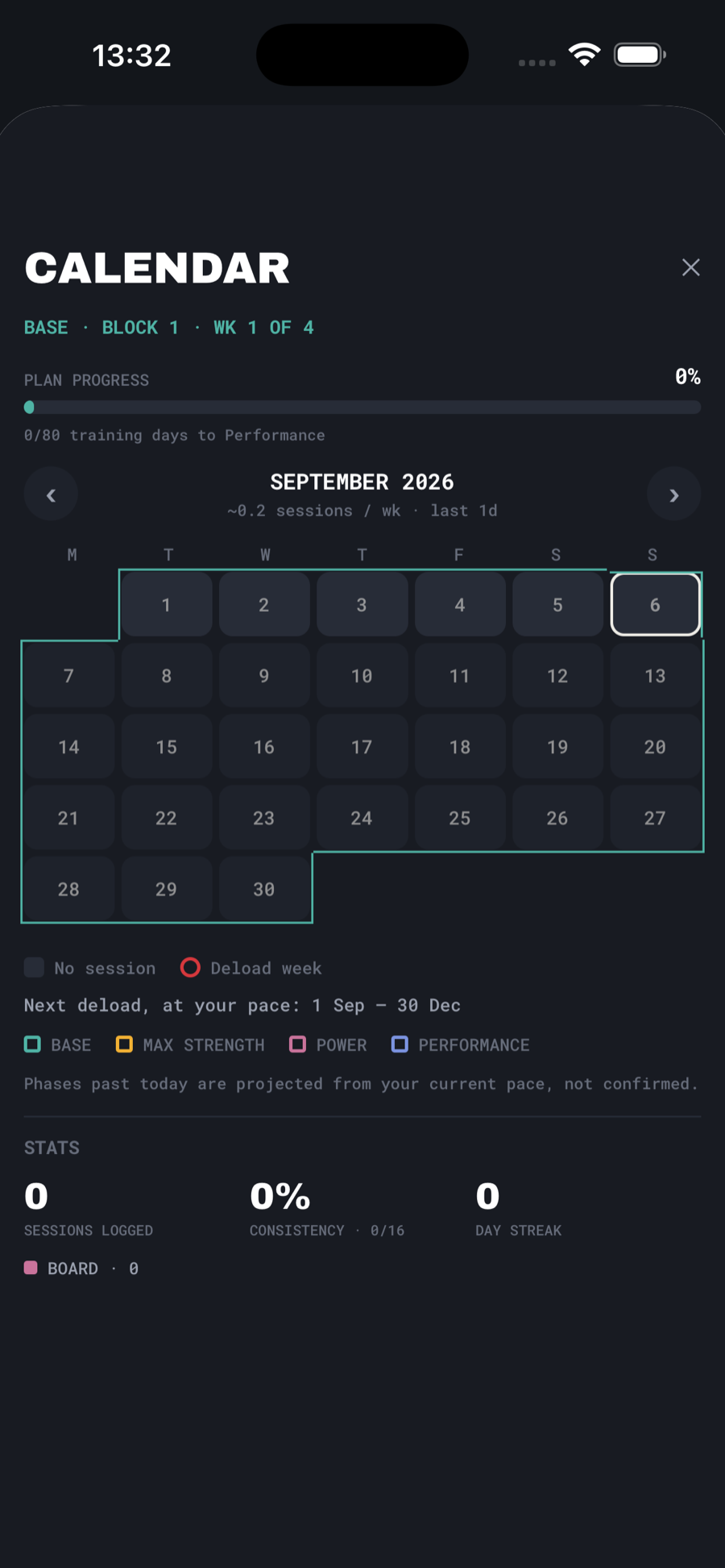
Calendar view of logged sessions
Every session you've logged
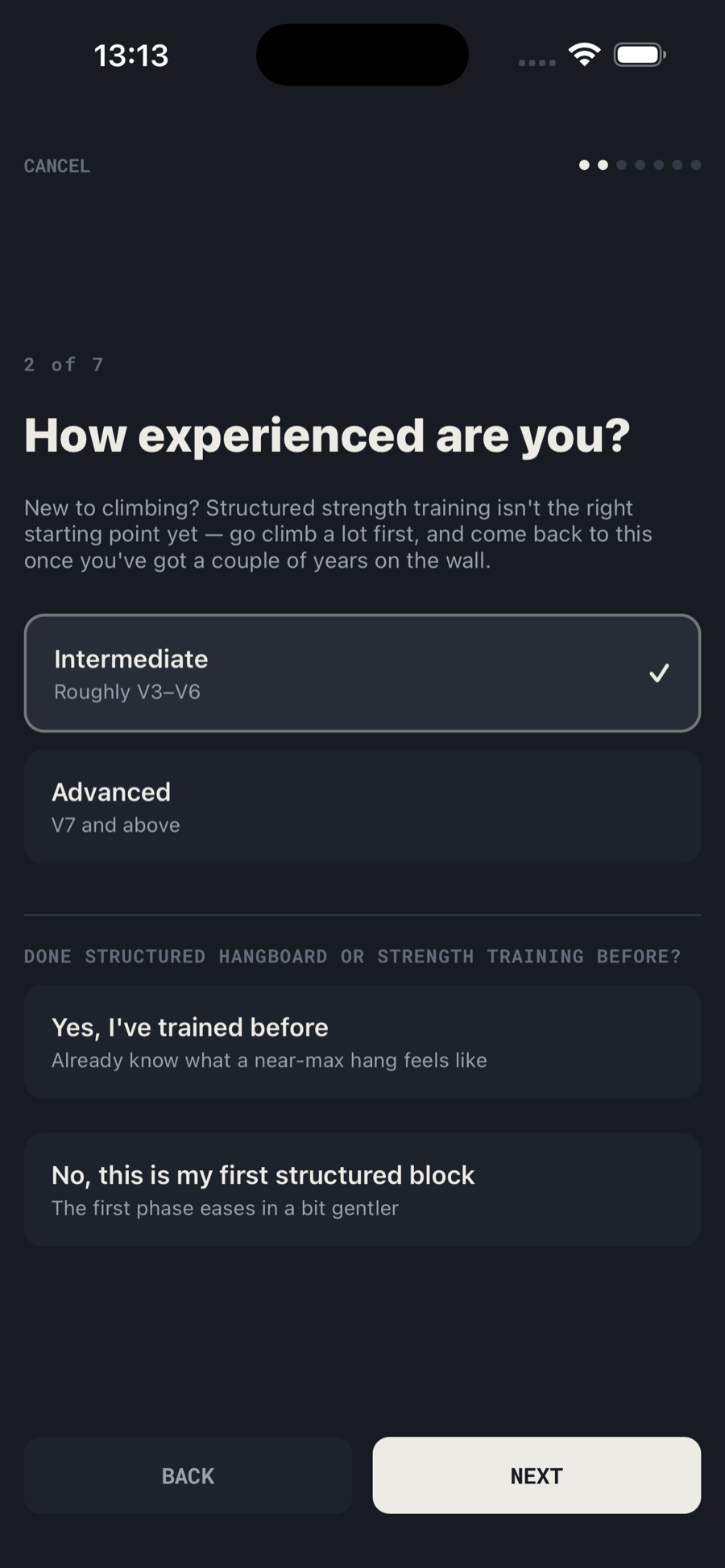
Quiz step asking about experience level
A quiz that's honest about levels
Quiz step asking what equipment you have
Only what you can actually do
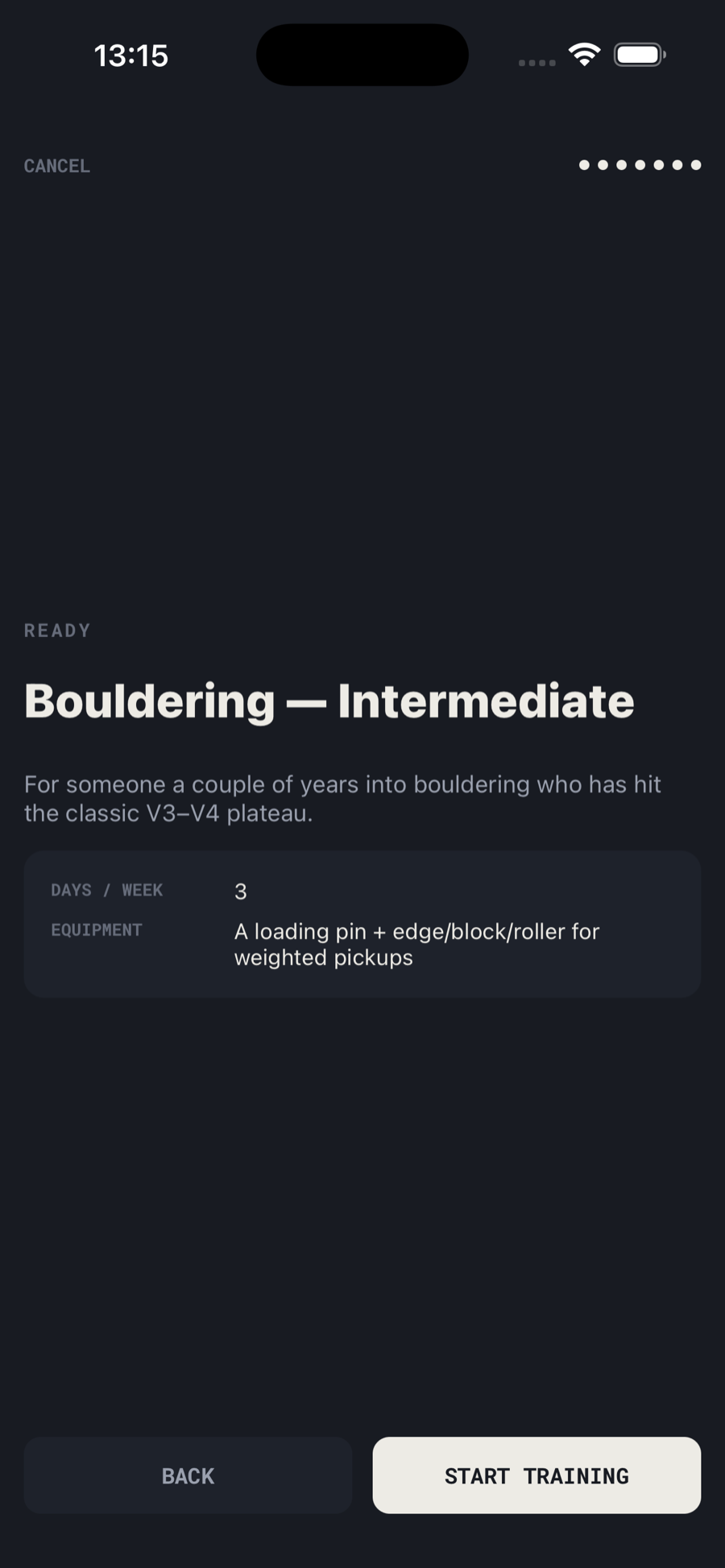
Summary of the assigned plan
Your assignment, before you start
Where the numbers come from

Sourced, cited, and corrected when we got it wrong.

The protocols in Deadpoint are drawn from published climbing-training work, cited per template in the source itself. Here's what that actually rests on — including the bits that are coaching judgement rather than evidence, because pretending otherwise would be worse than useless.

Added-weight hangboard training improves grip strength

Mundry et al., Scientific Reports, 2021 · DOI 10.1038/s41598-021-92898-2

A randomised controlled trial across 30 climbers at UIAA VI–VIII (roughly French 6a–7c+) found added-weight hangboard training significantly improved grip strength over eight weeks. This is the strongest single piece of evidence behind the max-hang work in every template.

The MaxHangs cycle: 4 weeks added weight, then 4 weeks smaller edge

Eva López's protocol · via strengthclimbing.com's write-up

An eight-week structure alternating Maximum Additional Weight and Minimum Edge Depth blocks, with 48 hours between sessions as sufficient recovery. The app uses her margin-before-failure approach rather than true one-rep-max attempts: pick a load where your genuine limit sits a few seconds past the prescribed hang, not exactly at it.

Periodisation, and knowing when to stop adding volume

Lattice Training

Strength work belongs in a base period — it's the slowest quality to adapt, and it sets up power later. Power work gets introduced two to six weeks out from a goal. And two structured strength/power sessions a week is the target: past that point, more doesn't buy more adaptation, just more fatigue. That cap is why the engine will tell you to rest.

Why there's no campus board work for intermediates

Lattice Training; prerequisite protocol via climbmaxxing.today

Lattice explicitly cautions intermediate climbers against self-directed campus training without a coach's direct guidance. Commonly cited gates before it's appropriate at all: a one-arm hang around 20mm for ~20 seconds, and ten strict pull-ups. Rather than include it with a warning, the intermediate templates use explosive pull-ups for the same power-conversion stimulus.

A correction we caught ourselves

An earlier draft of the advanced template claimed the Mundry RCT studied exclusively advanced climbers. It didn't — the 30 subjects spanned UIAA VI–VIII, which is intermediate through advanced. The claim was checked on a verification pass, found to be an overreach, and corrected in the source. It's noted here because a training app quietly overstating its evidence is exactly the thing you should be suspicious of, and the correction is still sitting in the code with the reasoning attached.

Everything above informs the templates; none of it was copied from any paid programme's proprietary content. Where a number is coaching judgement rather than a cited finding — most of the set-and-rep specifics are — it's marked as such in the source rather than dressed up as research.
Honest bit

If you're new to climbing, don't buy this.

Deadpoint has no beginner tier, and that's deliberate — it was removed rather than hidden. If you've been climbing under a couple of years, structured finger training is close to the worst use of your time and a decent way to hurt yourself. Go climb a lot, get good at moving, and come back. The app's floor is intermediate — roughly V3–V6 bouldering or French 6a–6c — because that's where specific strength work starts paying off in a way volume alone doesn't.

Not medical advice

Deadpoint prescribes physical training loads. It isn't a medical device, it doesn't diagnose anything, and the injury flags in the quiz add general prevention work and caution notes — not treatment. If something is currently painful or flaring up day to day, see a physio before training through it.

Pricing

One subscription. Cancel whenever.

Monthly

£0.99/ month

Everything in the app. No feature tiers, no add-ons.

Annual

£9.99/ year

The same thing, at about ten months for twelve.

Billed through the App Store. Manage or cancel any time in iOS Settings.

Questions

FAQ

What equipment do I actually need?

A hangboard or any decent edge is the real floor — that's what the finger sessions are built around, and you can max-hang on an edge without owning a purpose-built board. A pull-up bar (or a gym, which counts as having one) unlocks the pulling sessions. A weighted pickup rig is optional; if you have one, you can choose it over hangs for your main finger lift. Tell the app what you've got and it only shows you exercises you can actually do.

Does it work if I only have a hangboard?

Yes. Your finger sessions run in full. Your pull day drops to a warm-up and antagonist work, because there's no honest substitute for weighted pull-ups without something to hang off — we'd rather show you a short session than invent filler.

Can I change my answers later?

Any of them, in Settings, whenever. Days per week, equipment, weaknesses, injury flags, a trip date, even switching from bouldering to sport. Your plan updates going forward and your history and block progress carry on untouched.

What happens if I miss a week?

The engine notices. It reads your actual log rather than a calendar, so a layoff gets you eased back in rather than dropped into whatever week the spreadsheet says you should be on.

Is this coaching?

No. It's a structured programme that adapts to what you log. It can't watch you climb, can't assess your technique, and doesn't replace a coach who can. If you can afford real coaching and want to get properly good, get real coaching.

How do I cancel?

iOS Settings → your name → Subscriptions → Deadpoint → Cancel. Nothing to email us about, and you keep access to the end of the period you've paid for.

Can I delete my account and data?

Yes, from inside the app — Settings → Delete Account. It removes your account and the training data attached to it.

Still stuck, or want something built?

Deadpoint is made by one person, and you'll get a real reply.

Contact support

Your plan, every day.

Built around your answers. Decided by what you actually did.

Download on iOS